
Search for “crystal radio kit” and many results are actually battery-powered AM/FM radio kits. They can be fun, but they aren’t crystal radios.
How to tell a real crystal set
- No battery, no battery holder
- A diode (or crystal and cat’s whisker) as the detector
- A coil, often a tuning capacitor
- A high-impedance earpiece
- Needs a long antenna and a ground
- A battery holder or USB power
- An integrated circuit (chip) on the board
- “AM/FM” on the box: FM needs power
- A loudspeaker
- Works with only a short built-in antenna
Kits we know about
From each maker’s own listing or manual. We haven’t built these ourselves. If you have, we’d like to hear how it went: yoavGdev@protonmail.com.
Vectronics VEC-121K
Crystal set- Tuning
- 365 pF variable capacitor
- Inside
- PVC coil form and 100 ft of 18 AWG wire to wind the coil yourself (66 turns, about 217 µH), 1N34A diode, 27 kΩ resistor, crystal earpiece, pine board, Fahnestock clips. No soldering.
- Notes
- The textbook circuit, with the antenna and diode at the top of the coil, so tuning is broad. Adding the two Level 2 changes, a small antenna capacitor and a diode tap, is easy.
- Where
- MFJ / Vectronics
MiniScience Advanced Crystal Radio Kit (CRADIO)
Crystal set- Tuning
- Adjustable coil (no variable capacitor)
- Inside
- Laser-cut wooden frame, pre-wound coil on a plastic form, 1N34A diode, 120 pF capacitor, 82 kΩ resistor, crystal earphone, Fahnestock clips. No soldering or batteries.
- Notes
- Replaces MiniScience’s older basic kit.
- Where
- MiniScience
Science Buddies Crystal Radio Kit
Both- Tuning
- Coil with a 120 pF ceramic capacitor
- Inside
- 1N34A diode, 120 pF capacitor, 82 kΩ resistor, wooden base with clips, an earpiece, and a pre-assembled amplifier and speaker that needs a 9 V battery.
- Notes
- With the earpiece it is a true crystal set; with the speaker it is a powered radio. Popular for science fairs.
- Where
- Home Science Tools
Carolina AM Crystal Radio Kit
Powered- Tuning
- See the listing
- Inside
- Includes a speaker with a rechargeable battery.
- Notes
- For grades 9–12. A good lesson, but not a battery-free set.
- Where
- Carolina Biological
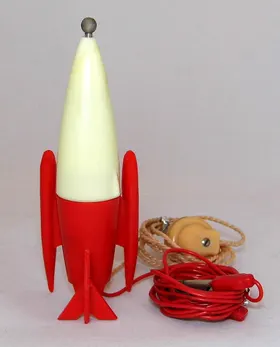
Old kits turn up on eBay and at radio swap meets: Philmore sets, Heathkit’s CR-1 (sold about 1957–62) and Japanese “rocket” radios. Listings checked November 2026; we don’t earn anything from these links.
Kit or scratch-build?
A kit saves hunting for parts, which is useful for the variable capacitor and a genuine germanium diode. A scratch build teaches more and costs less. For a child or a classroom, a no-solder kit is the gentlest start. For anyone who enjoys making things, the classic set is more rewarding.
Worth knowing
- The Xtal Set Society’s “Little Wonder” kit, recommended in many older guides, is gone: the society has closed.
- Kits that use a 335 pF rather than 365 pF capacitor may not reach the bottom of the band; check with the tuning-range planner.
- Kits with a pre-wound coil save the most fiddly step, but children’s kits often have thin instructions; an adult helper makes a big difference.
Image credits
Photos from Wikimedia Commons. Public-domain images need no credit, but we give one anyway. Creative Commons images are used under the licence shown.