The three parts that matter most are the diode, the earphone and the tuning capacitor. Two of them got harder to buy in recent years. Shopping lists for each build are at the end.
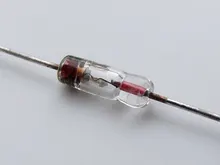

Germanium diode
- Look for
- 1N34A, 1N60, OA90 (old stock), or the modern BAT46
- Why
- Low turn-on voltage, so it hears weak stations.
- Watch out
- Genuine 1N34A and 1N60 diodes are no longer manufactured. What’s sold is old stock or relabelled parts, often silicon. Test before use (below).
- Salvage from
- Old transistor radios, vintage boards
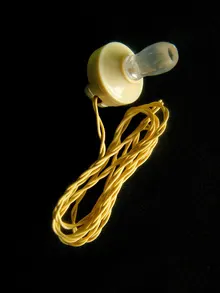

Earphone
- Look for
- Crystal / ceramic earpiece, or 2,000 Ω+ headphones
- Why
- Needs very little power to make sound.
- Watch out
- Cheap crystal earpieces vary hugely and often fail at glued joints or hair-thin leads. Test it before blaming the radio (below). Modern earbuds won’t work directly.
- Salvage from
- Vintage headphones, sound-powered phones
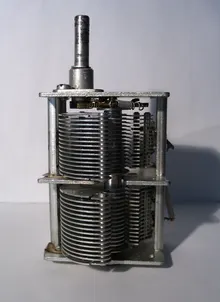

Variable capacitor
- Look for
- ~365 pF single section; or a two-section “polyvaricon” with both sections in parallel
- Why
- Tunes the radio across the band.
- Watch out
- Small plastic polyvaricons from AM radios are often 2 × 140–270 pF. Wire the sections in parallel for more range, then check coverage with the tuning-range planner.
- Salvage from
- Dead AM transistor radios, clock radios, valve radios
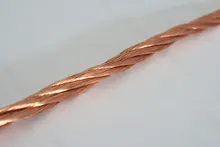

Wire and coil form
- Look for
- 22–28 AWG enamelled copper; litz for high-performance coils; a plastic tube for the form
- Why
- Makes the coil.
- Watch out
- Scrape the enamel at every connection. Cardboard absorbs moisture and wastes signal, so use a plastic form (PVC pipe, a pill bottle) for anything beyond Level 1.
- Salvage from
- Transformers and motors (often too thin); ferrite rods with litz from old AM radios are gold
Antenna wire
- Look for
- Any insulated copper wire, 15–60 m
- Why
- Your radio’s only source of energy.
- Watch out
- Thin wire breaks in wind. Use something sturdy outdoors.
- Salvage from
- Old extension cords, speaker wire
Resistor
- Look for
- 47–150 kΩ, any type
- Why
- DC path across a crystal earpiece.
- Watch out
- Without it, a crystal earpiece can go silent. Higher values are louder but less forgiving.
- Salvage from
- Any junk electronics
Which diode, now that the classics are gone?
The germanium point-contact diodes that every old guide recommends are obsolete. You can still find them, but a lot of “1N34A” for sale are relabelled silicon parts. A modern Schottky diode, the BAT46, comes very close and is still made. And no diode is “best” in every set; it depends on the circuit around it, so it pays to try two.
| Diode | Type | Verdict |
|---|---|---|
| 1N34A | Germanium | The classic. No longer made: old stock only, and many are fakes. |
| 1N60 / 1N60P | Germanium | Common in kits. Also discontinued: buy from reputable sellers and test. |
| OA90, OA91, AA112, OA625, GAY63 | Germanium (European) | Vintage types; old stock. In one German comparison OA625 and GAY63 beat AA112. |
| BAT46 | Schottky | The best-supported modern substitute: in measurements its curve is close to the 1N34A’s. Still made. |
| 1N5711 | Schottky | Mixed reports: liked in some high-performance sets, poor in simple ones. |
| 1N4148, 1N4001 | Silicon | Too high a turn-on voltage. Works only right next to a transmitter. |
Test a “germanium” diode
Set a multimeter to diode mode and measure with the red lead on the end without the stripe:
| Reading | What it is |
|---|---|
| ≈ 0.15–0.35 V | Genuine germanium (or a low-barrier Schottky like the BAT46). Good for crystal radio. |
| ≈ 0.55–0.75 V | Silicon. It will work only on very strong signals. |
Many builders fit a small switch to flip between two diodes, and keep whichever wins on their favourite station.
Test your earpiece
Put the earpiece in your ear and briefly touch its two wire ends together, or touch them to the two ends of a 1.5 V battery. You should hear a click. Silence means a broken lead or joint, so the earpiece, not your radio, is the problem.
Use the headphones you already have
Modern headphones are around 32 Ω, far too low for a crystal set. Connected directly, almost nothing comes out. A small transformer used backwards fixes that: connect your radio to the high-voltage (mains or “100 V line”) side, and your headphones to the low-voltage side. A small 6 V mains transformer, or a 100 V loudspeaker-line transformer, works; try each tap and keep the loudest. (Never plug such a transformer into the mains; here it carries only the radio’s microwatts.) The earphone matching helper shows how much this gains.
Vintage headphones
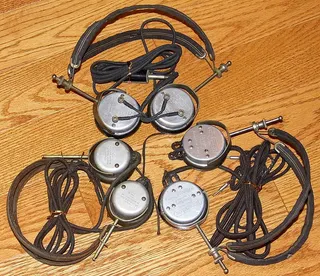

Old high-impedance headphones, typically marked 2,000 Ω or more, were made for crystal sets, and good ones are very sensitive. They turn up at flea markets and online auctions. Check both earpieces work: an ohmmeter should read roughly the marked resistance across the plug. Cords and headbands are often perished, but the earpieces themselves usually survive. US Navy sound-powered telephone headsets (600–1,200 Ω) are superb with a matching transformer whose primary is 50–100 kΩ or more.
Shopping lists
What to buy for each build, and where we would buy it. For Level 3, see the budget and full parts tables on its own page.
Cardboard-tube radio (Level 1)
| Item | What exactly | Where |
|---|---|---|
| Cardboard tube | Paper-towel tube | Your kitchen |
| Magnet wire | 26 AWG, about 20 m | Remington Industries |
| Diode | 1 × BAT46 | DigiKey, Mouser |
| Crystal earpiece | 1 | Antique Electronic Supply |
| Resistor | 1 × 47–100 kΩ | DigiKey, any electronics shop |
| Crocodile clip leads | 4–6 | Any electronics or hardware shop |
| Antenna wire and ground stake | 20–30 m of insulated wire; a metal stake | Hardware store |
Classic tuned set (Level 2)
| Item | What exactly | Where |
|---|---|---|
| Coil form | Plastic tube about 60 mm across | Hardware store (PVC pipe), or a pill bottle |
| Magnet wire | 24 AWG, about 15 m | Remington Industries |
| Variable capacitor | 365 pF, single section | Antique Electronic Supply, or salvage a polyvaricon from a dead AM radio |
| Fixed capacitors | 1 × 47 pF, 1 × 82 pF ceramic | DigiKey |
| Diode | 1 × BAT46 | DigiKey, Mouser |
| Crystal earpiece + resistor | 1 earpiece, 1 × 47–150 kΩ | Antique Electronic Supply, DigiKey |
| Board and terminals | A wooden board, 4–6 screw terminals or clips | Hardware store |
| Antenna and ground | 20–30 m of wire; a stake or metal pipe | Hardware store |
Apartment radio
| Item | What exactly | Where |
|---|---|---|
| Wooden battens | 2 × 90 cm | Hardware store |
| Insulated wire | About 35 m of thin solid hook-up or bell wire | Hardware store |
| Variable capacitor | 365 pF | Antique Electronic Supply, or a salvaged polyvaricon |
| Diode, earpiece, resistor | BAT46, crystal earpiece, 47–100 kΩ | DigiKey, Mouser, Antique Electronic Supply |
Classroom loop radio (per group)
| Item | What exactly | Where |
|---|---|---|
| Cardboard, foil, sheet protector, tape | The classroom cupboard | |
| Bell or hook-up wire | About 18 m | Hardware store |
| Diode, earpiece, resistor | BAT46, crystal earpiece, 47–150 kΩ | DigiKey, Mouser, Antique Electronic Supply |
We don’t earn anything from these links. Shop links checked November 2026.
Shops
| Supplier | Good for |
|---|---|
| Modern Radio Laboratories | Crystal set and one-tube radio plans, handbooks and parts. Still trading in 2026. |
| Antique Electronic Supply | Variable capacitors, crystal earphones, vintage-radio parts. |
| MiniScience / Science Kit Store | Crystal radio kits and packs of 1N34A diodes. |
| Hobbytech | High-performance crystal radio kit and advice. |
| Mouser, DigiKey, Farnell | BAT46 and other current diodes, resistors and magnet wire. Genuine parts. |
| eBay, flea markets, radio swap meets | Vintage headphones, air-spaced capacitors, old radios to salvage. |
Many older guides send you to the Xtal Set Society / Midnight Science for kits and 365 pF capacitors. It has closed; see the archived copy in the Library.
Image credits
Photos from Wikimedia Commons. Public-domain images need no credit, but we give one anyway. Creative Commons images are used under the licence shown.
- Germanium Diode 1N60 Aomorikuma · CC BY-SA 3.0
- Crystal Earpiece Nvtj · CC BY-SA 3.0
- Air variable capacitor Solaris2006 · CC BY-SA 3.0
- Enamelled litz copper wire Alisdojo · CC0
- A Trio Of 1920s-Era Radio Headphones, C. Brandes Superior Matched Tone (T), Western Electric (L), Brandes Navy Type Matched Tone (R), All Made In USA (36399282866) Joe Haupt from USA · CC BY-SA 2.0