A crystal radio itself is harmless: it runs on microwatts. The risks come from the outdoor antenna, and from putting it up. Three rules cover most of them.
- Never near power lines. Put the antenna where it could not touch a power line even if the wire, a support or you fell.
- Never in a storm. Don’t put up, touch or listen on an outdoor antenna when thunder is possible.
- Ground it when you’re done. Disconnect the antenna from the radio and connect it straight to ground.
Power lines
This is the danger that kills people putting up antennas. Every overhead wire should be treated as live, including the low-voltage line from the street to your house. An antenna wire, a metal pole or a ladder that touches one can be fatal to whoever is holding it.
- Look up before you choose a route, and stay well clear of every overhead line, in every direction the wire or a support could fall.
- Never throw a line over a tree that has power lines running near or through it.
- If an antenna ever comes down onto a power line, keep away from it and from anything it touches, and call the power company.
Lightning
A long wire high in the air collects static charge from nearby storms, and a nearby strike can induce a large surge in it. A direct strike is rare but nothing in a home setup will stop one. So the protection is simple: when the antenna isn’t in use, it isn’t connected to anything indoors.
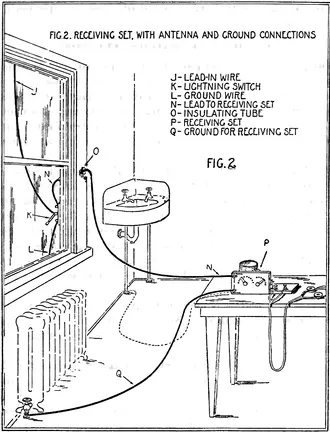
The 1922 government guide used a lightning switch: a large knife switch where the lead-in enters the house, thrown one way to connect the radio and the other way to connect the antenna straight to ground. The same idea still works: when you finish listening, unclip the antenna from the radio and clip it to a ground wire outside.
- Disconnect before a storm arrives, not when it is overhead.
- During a storm, don’t touch the antenna, the lead-in or the ground wire.
A permanent outdoor antenna
If the antenna stays up, it should be installed like any other outdoor antenna. In the United States the rules are in the National Electrical Code, Article 810 (radio and television equipment). In outline:
- The lead-in passes through a listed antenna discharge unit where it enters the building. It drains static to ground and limits surges.
- The discharge unit is connected to the building’s grounding electrode system, the same ground the mains wiring uses, by a ground wire run as straight and short as practical. For a receiving antenna, that wire must be at least 10 AWG copper.
- A separate ground rod for the radio is allowed, but it must be bonded to the building’s ground, so the two can’t be at different voltages during a strike.
- Metal masts and supports are grounded too.
Other countries have similar rules. Check the edition your area has adopted, and ask an electrician if you aren’t sure.
Grounds
- Never use a gas pipe as a ground.
- A water pipe is only a ground if it is metal all the way into the earth. Many houses now have plastic sections.
- Don’t connect a radio to the earth pin of a mains socket. Besides bringing in electrical noise, it ties your experiment to the house wiring.
- If you use a mains transformer backwards to drive headphones, it carries only the radio’s tiny signal. Never plug it into the mains.
Putting it up
- Stay off the roof. A wire to a tree, a fence post or an upstairs window works almost as well.
- Use a ladder only with someone holding it, and never near overhead lines.
- To get a line over a branch, tie a small weight to fishing line and throw it, standing well clear of where it will land. Keep people and windows out of the way.
- Run the wire high enough that nobody walks into it, and mark low sections so they can be seen.
At the workbench
- Soldering irons and hot glue burn: use a stand, and supervise children.
- Galena is lead sulfide, and the old Wood’s metal for mounting crystals contains lead and cadmium. Wash your hands after handling them, and keep them away from small children.
- Razor blades for foxhole detectors are sharp, and bluing one with a flame is a job for an adult.
- Small parts such as diodes, earpieces and clips are a choking hazard for young children.
Sources
- NFPA 70, National Electrical Code, Article 810: Radio and Television Equipment (check the edition adopted where you live). A plain-language summary: EC&M, “Article 810”.
- US Bureau of Standards, Circular 120 (1922, public domain): the lightning switch.
Image credits
Photos from Wikimedia Commons. Public-domain images need no credit, but we give one anyway. Creative Commons images are used under the licence shown.
- Fig. 2, Receiving set with antenna and ground connections US Bureau of Standards, Circular 120 (1922) · Public domain